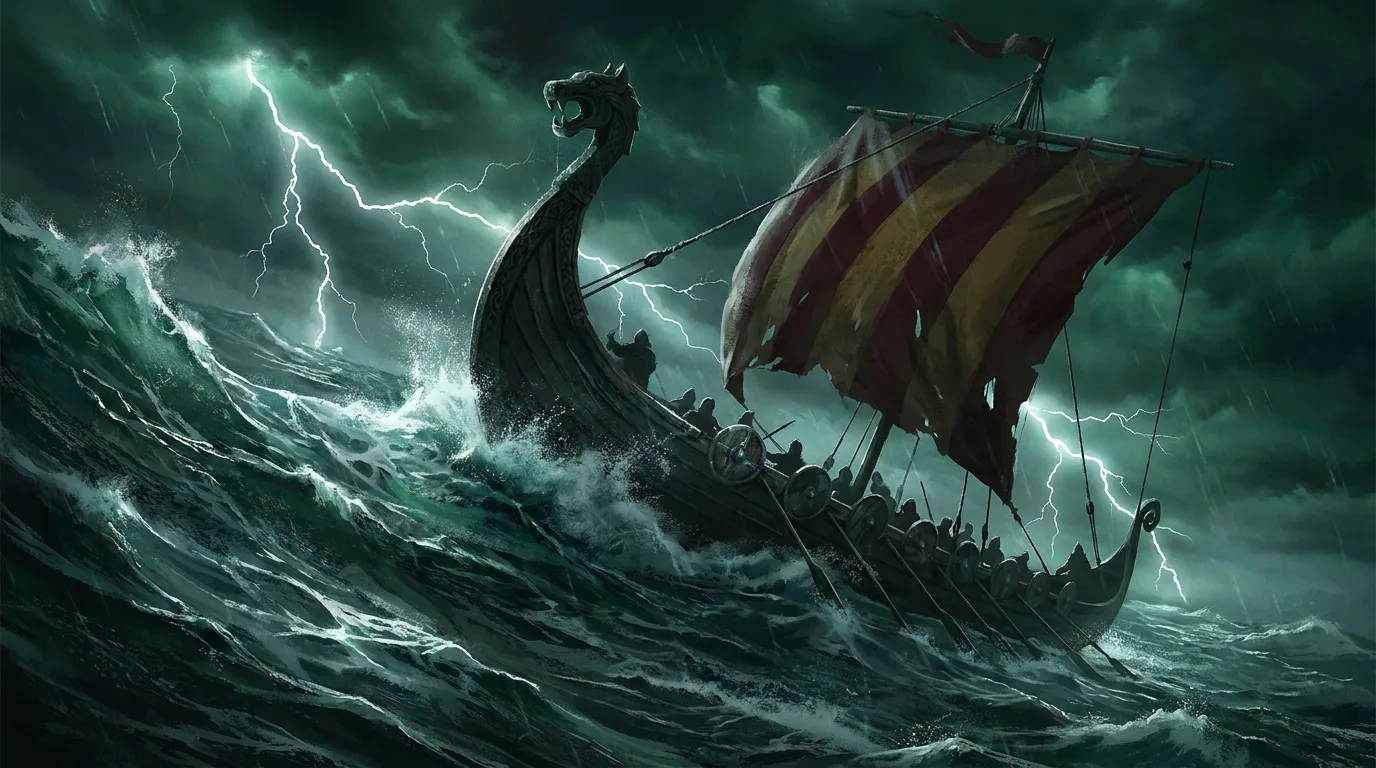
A dragon-prowed Viking longship with a striped sail climbing a huge storm wave under a green-black sky split by lightning, shields lining its hull

Viking Name Generator

Warrior names with earned epithets: shieldmaidens, war-bands, longships, and berserkers of the whale-road.

Viking Name Generator

Generate battle-worn Viking warrior names with epithets, shieldmaiden names, clan and war-band names, longship names, and berserker names - free and instant, right in your browser.

How Viking names and epithets worked

A Viking name in the sagas is rarely just a given name. It is a given name plus a reputation: Eirik the Red, Ragnar Lodbrok, Aud the Deep-Minded, Thorir Wood-Leg. That second part, the byname or epithet, is what this generator is built around. It produces full warrior names with earned-sounding epithets, shieldmaiden names, clan and war-band names, longship names, and berserker names. Pick a type and a batch size, press the button, and keep pressing until something sounds like it has a story behind it.

How Viking-age bynames actually worked

In Viking-age Scandinavia, given names repeated heavily within families; a district might hold a dozen men named Thorstein. Bynames solved the practical problem of telling them apart, and they were bestowed by other people, never chosen by the bearer. Some recorded deeds (the Far-Traveled, after a voyage to the east), some recorded temperament (the Quiet, the Wise), some were blunt about a physical trait, and some were openly mocking and stuck anyway. The sagas preserve hundreds of them, from the fearsome to the surprisingly gentle. This generator sorts its epithets into the same tone bands you find in the sources: fearsome reputations like the Bone-Breaker, cunning ones like the Silent, and storied ones like Wave-Strider that read as a life compressed into two words.

War-bands, clans, and who fought under a name

Viking crews were not national armies. A raiding force was a war-band: a crew or several crews bound to a leader by oath, kinship, and the promise of a share. Groups were commonly known by their leader, by their home district, or by a totemic banner animal, which is why the generator builds group names from patterns like a totem clan, Sons of the Wolf, or a shield name carried by the whole line. A good war-band name should work when shouted: short, concrete, and tied to an image the enemy will remember.

Naming a longship

Ships were the most valuable things most Vikings would ever touch, and they were named with real care. Recorded and reconstructed ship names lean on sea-imagery, serpents and dragons (the carved prow beast), weather, and speed: the Long Serpent of Olaf Tryggvason is the most famous. The generator follows that grammar, compounding sea, storm, and serpent words into names like Wave-Cutter or Storm-Serpent that would sit naturally on a carved prow.

Using the results in games and fiction

A few practical tips. First, match the epithet to the point in the story where the audience meets the character: a young fighter should probably not yet be the Skull-Splitter, but might become one on the page. Second, feel free to split results and recombine them; the given names and epithets are interchangeable parts. Third, remember that bynames are given by others, so the difference between what a character is called to their face and behind their back is free characterization. Finally, if you need the historically strict version of a personal name, an authentic Old Norse given name with its meaning and a proper patronymic, use our sibling Norse name generator; this site deliberately owns the warrior register, and that one owns the linguistic one. Everything generated here is free to use in personal and commercial projects alike.

Worked examples

Frequently asked questions

What were Viking epithets, and how did people get them?
In the Viking Age most people carried a byname alongside their given name: a nickname earned from a deed, a habit, a physical trait, or a famous voyage. Sagas record figures like Eirik the Red and Aud the Deep-Minded. Epithets were given by others, not chosen, which is why the best ones sound like a reputation: the Bone-Breaker, the Silent, Wave-Strider. This generator builds names in that tradition, pairing a period-style given name with an earned-sounding byname.
Are these real historical Viking names or invented ones?
Both, deliberately. The given-name roots are real Viking-age Scandinavian names in commonly anglicized forms (Ragnar, Astrid, Sigurd, Freydis), while most epithets, clan names, and ship names are invented in the authentic style rather than copied from any one saga. If you want strictly authentic Old Norse given names with their meanings and patronymics, use our sibling Norse name generator at norse.namesplease.app; this tool is for the warrior register.
Were shieldmaidens historically real?
The honest answer is: debated. Shieldmaidens appear throughout the sagas and in accounts of legendary figures like Lagertha and Hervor, and some archaeological finds, most famously the Birka grave Bj 581, show women buried with full weapon sets. Whether that proves women routinely fought in Viking war-bands is still argued by historians. For games and fiction the shieldmaiden is a well-grounded archetype with real medieval sources behind it, and this generator treats her as such.
Can I use these names for my game character or novel?
Yes, that is exactly what the tool is for. The names work well for tabletop campaigns, online RPG characters, historical fiction, fantasy novels, and worldbuilding projects. Generate a batch, keep the ones that fit the character's reputation, and feel free to mix parts: take the epithet from one result and attach it to a given name from another.
Can I use a generated name commercially, in something I sell?
Yes. Names themselves are not copyrightable and we claim no rights over the generator's output, so you can use the results in commercial novels, games, brands, and products. For a commercial project it is still worth running a quick search to confirm the exact name is not already a registered trademark in your market.
Is the generator free, and do you store what I generate?
It is completely free: no account, no daily limit, no premium tier. The generator runs entirely in your browser, so your selections and the names it produces never leave your device and nothing is stored on a server. Once the page has loaded it even keeps working if your connection drops.
How is this different from the Norse name generator?
They split the territory. This Viking generator owns the warrior register: full battle names with epithets, shieldmaidens, clan and war-band names, longship names, and berserkers. The Norse generator at norse.namesplease.app owns authentic Old Norse given names with their meanings and proper patronymics (the -son and -dottir forms). Use Norse when you need a historically grounded personal name, and Viking when you need a reputation.

Guides